

 Last Updated: 06-12-2026
 Read Time – Est:

Tampa child endangerment defense from a board-certified former prosecutor with nearly 15 years of criminal trial experience.
If you have been arrested, charged, or contacted by detectives or Department of Children and Families investigators regarding child endangerment allegations in Tampa, the case may produce serious criminal exposure along with family law proceedings that may affect custody, employment, and professional licensing. Florida treats child endangerment, child neglect, and contributing to the delinquency of a minor as felony offenses in most circumstances, with sentencing tied to the nature of the conduct and any alleged injury to the child. Our Tampa, FL child endangerment defense lawyer at StechLaw Criminal Defense has practiced criminal law in the Tampa Bay area for nearly 15 years and has tried more than 100 jury trials and 250 non-jury cases. We offer a free consultation to discuss your situation in a private and confidential setting.
Child Endangerment Defense Lawyer Tampa FL
Child endangerment under Florida law encompasses a range of offenses involving alleged failure to provide proper care or supervision, alleged exposure of a child to dangerous conditions, or alleged conduct contributing to the delinquency of a minor. The category includes child neglect, contributing to the delinquency or dependency of a minor, leaving a child unattended in a vehicle, and related conduct that produces a substantial risk of physical or mental injury to a person under 18.
Tampa child endangerment cases typically originate from reports filed with the Florida Department of Children and Families, mandated reporter calls from teachers or healthcare providers, or law enforcement responses to scenes involving children. Tampa Police Department detectives, the Hillsborough County Sheriff’s Office Child Protective Investigations Division, and DCF investigators frequently coordinate from the earliest stages of an investigation. The interaction between the criminal case, the DCF investigation, and any family court proceedings makes early involvement of defense counsel particularly important.
Types of Child Endangerment Cases We Handle in Tampa
Child endangerment allegations arise in a wide range of factual circumstances, from disputes between parents in a divorce or custody case to allegations involving caregivers, family friends, or strangers. The list below reflects the categories of Tampa child endangerment matters our firm handles on a regular basis.
- Child neglect. Allegations involving a caregiver’s failure to provide care, supervision, or services necessary to maintain the child’s physical or mental health, including allegations of inadequate food, housing, medical care, or supervision.
- Aggravated child neglect. Cases in which the alleged neglect is alleged to have caused great bodily harm, permanent disability, or permanent disfigurement, which produces second-degree felony exposure under Florida law.
- Leaving a child unattended in a vehicle. Allegations involving a child under six years of age left unattended in a vehicle for any period that exceeds the statutory threshold, or for a shorter period if injury results.
- Contributing to the delinquency of a minor. Allegations that a person engaged in conduct that caused or tended to cause a child under 18 to engage in delinquent behavior, runaway status, or dependency.
- Child abuse and aggravated child abuse allegations. Allegations involving intentional physical contact, restraint, or conduct alleged to have caused mental or physical injury, frequently charged alongside assault and battery.
- Endangerment involving drugs or controlled substances. Cases in which the presence of controlled substances in the child’s environment, exposure to drug manufacturing activity, or alleged drug use during pregnancy gives rise to endangerment charges, frequently overlapping with drug crime charges.
- Endangerment involving firearms. Allegations involving alleged unsafe storage or accessible placement of firearms in proximity to children, which may produce additional gun crimes charges.
- DUI with a minor passenger. DUI allegations involving a minor passenger trigger enhanced penalties under Florida law and frequently produce parallel child endangerment counts in addition to the DUI case.
- Domestic violence in the presence of a child. Allegations involving alleged conduct in the presence of a child during a domestic dispute, frequently charged alongside Tampa domestic violence counts.
- Endangerment arising from custody and family court disputes. Allegations originating from contested divorce, custody, or visitation proceedings, which frequently involve competing accounts of caregiving conduct and parallel family court litigation.
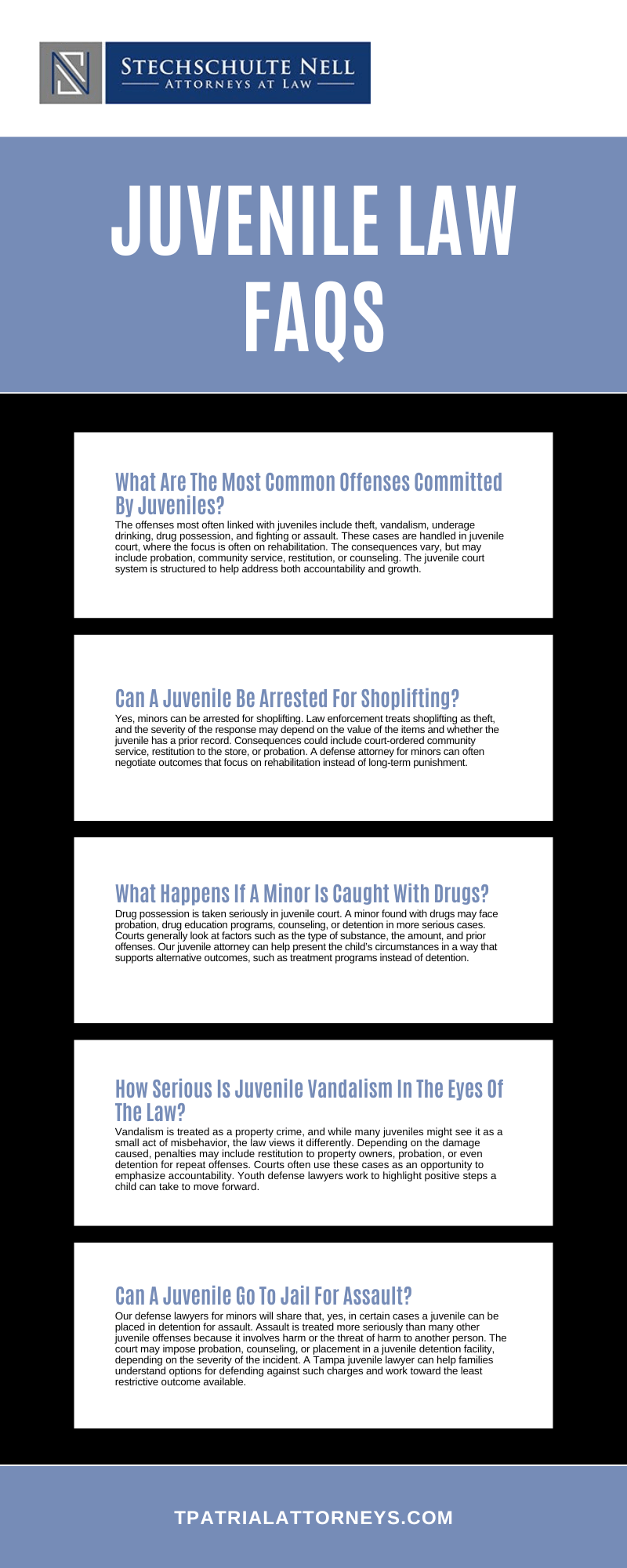
Tampa Juvenile Defense Infographic
Why Choose StechLaw Criminal Defense as my Child Endangerment Defense Lawyer in Tampa, FL?
Child endangerment cases turn on the credibility of witnesses, the assessment of caregiving conduct, and the documentary record built from DCF reports, medical records, school records, and witness statements. Our criminal defense work in Tampa requires familiarity with the procedural framework of the Thirteenth Judicial Circuit, the approach taken by the Hillsborough County State Attorney’s Office in cases involving children, and the parallel DCF and family court proceedings that may run alongside the criminal case. Ben Stechschulte established StechLaw Criminal Defense in 2012 following three years as a Hillsborough County prosecutor.
Board-Certified Criminal Trial Lawyer
Ben Stechschulte holds Board Certification in Criminal Trial Law from The Florida Bar, a credential earned by fewer than 2% of attorneys in the state. The certification requires a minimum of five years of full-time legal practice, completion of 20 jury trials tried to verdict, and successful peer review evaluating character, ethics, and professionalism. Ben graduated from Stetson University College of Law in 2005, served as a Hillsborough County prosecutor for three years, and was recognized as a Rising Star by Super Lawyers® in 2015. Over the course of his career, he has tried more than 100 jury trials and 250 non-jury matters.
Trial Experience and Results
Child endangerment defense draws on the trial preparation, motion practice, and negotiation skills required across our broader criminal practice. A significant number of these cases turn on the credibility of caregiving accounts, the medical or expert evaluation of any alleged injury, and the parallel DCF record that may differ from the criminal investigation. Across our criminal defense work in Tampa and the surrounding area, we have secured acquittals, dismissals, charge reductions, and favorable plea outcomes for clients facing significant state exposure.
What Is Important To Understand About Tampa Child Endangerment Cases?
Charges, Penalties, and Defense Strategies for Child Endangerment Cases
Florida’s child endangerment framework includes several distinct offenses, with penalty exposure depending on the alleged conduct and any resulting injury. Child neglect without great bodily harm is generally a third-degree felony. Aggravated child neglect involving great bodily harm, permanent disability, or permanent disfigurement is a second-degree felony or first-degree felony depending on the circumstances. Contributing to the delinquency of a minor is generally a first-degree misdemeanor, although enhancements may apply.
Common child endangerment-related charges include:
- Child neglect
- Aggravated child neglect
- Child abuse
- Aggravated child abuse
- Contributing to the delinquency or dependency of a minor
- Leaving a child unattended in a vehicle
- DUI with a minor passenger
- Domestic violence in the presence of a child
- Endangering the welfare of a child through drug-related conduct
Defense strategies frequently focus on the caregiving context, the absence of intent to harm or neglect, the credibility of accounts produced by family members in contested custody settings, and the medical or expert evaluation of any alleged injury. Common avenues include challenges to DCF investigation methodology, suppression motions targeting statements made without proper warnings, motions to limit prejudicial character evidence, and negotiated resolutions that may include parenting programs, family services, or referrals to specialty programs in qualifying cases.
What Are Important Aspects of a Child Endangerment Case?
Several features of Tampa child endangerment practice influence how a case is built and defended.
- DCF investigations frequently run in parallel with the criminal case. The Florida Department of Children and Families conducts its own investigation under a separate civil framework, with its own findings and records that may become evidence in the criminal case.
- Family court proceedings may produce additional witnesses and evidence. Contested divorce, custody, and visitation matters frequently overlap with child endangerment allegations, and the resulting family court record may become part of the criminal case.
- Medical and expert testimony is frequently central. Alleged injuries to children typically require medical evaluation and expert interpretation, with disputes between prosecution and defense experts shaping the trial record.
- Mandated reporter context shapes the evidence. Reports filed by teachers, healthcare providers, and other mandated reporters frequently form the foundation of the prosecution, and the credibility and context of those reports become substantive issues at trial.
What Is The Child Endangerment Case Timeline?
Tampa child endangerment cases generally proceed through a sequence that may include both criminal and DCF tracks running in parallel from the earliest stages.
- Initial report and DCF investigation. A significant portion of cases originate from a report filed with the DCF abuse hotline by a family member, teacher, healthcare provider, or other mandated reporter, which triggers a DCF investigation under a separate civil framework.
- Law enforcement investigation. Detectives interview the child when appropriate, family members, witnesses, and the accused. Forensic interviews are frequently conducted at a child advocacy center.
- Charging decision and arrest or summons. The State Attorney’s Office reviews the evidence and determines whether to pursue criminal charges, with the defendant either arrested or notified through a summons.
- Arraignment and bond determination. Bond conditions frequently include no-contact provisions, supervised contact arrangements, and restrictions on residence with the child.
- Discovery and pretrial motions. Discovery typically includes DCF reports, medical records, child advocacy center recordings, school records, and witness statements.
- Plea negotiations or trial. A significant number of cases resolve through negotiated pleas or family services dispositions, although trial remains a viable option when the state’s evidence on caregiving conduct, intent, or causation is open to challenge.
- Sentencing. Sentencing follows the Florida Criminal Punishment Code and may include incarceration, probation, parenting programs, family services, and conditions related to contact with the child.
What Should You Bring to Your Child Endangerment Consultation?
Bringing the appropriate documents to an initial meeting enables a thorough review of the situation and an accurate discussion of the options available to you.
- The charging document, arrest paperwork, or notice of investigation
- Any police reports, DCF reports, or correspondence from investigators
- Medical records and school records relevant to the child
- Documents related to ongoing or recent custody, divorce, or visitation proceedings
- Communications with family members, the other parent, or anyone with knowledge of the alleged conduct
- Documents related to bond, pretrial release conditions, or detention
- Names and contact information for any witnesses
- Prior criminal history, particularly any prior offenses involving children
The initial meeting is treated as a confidential consultation. Complete documentation is not required to schedule a meeting; the documents you are able to supply assist in identifying the strongest defenses early.
What Are Important Florida Legal Resources for Child Endangerment Cases?
Tampa child endangerment cases proceed through the state criminal court system and frequently involve coordination with the Florida Department of Children and Families. The resources below can assist individuals seeking to understand how these matters are investigated, charged, and resolved.
- The Florida Department of Children and Families maintains information regarding child abuse and neglect reporting, the DCF investigation framework, and the services available through the agency.
- The Thirteenth Judicial Circuit maintains court information, judge assignments, and procedural rules for criminal and family matters in Hillsborough County.
- The Hillsborough County Clerk of Court maintains court records, filings in family and dependency matters, and online case search tools.
- The U.S. Department of Health and Human Services Children’s Bureau publishes federal research regarding child welfare, abuse and neglect prevention, and reporting practices.
- The Florida criminal statute of limitations for third-degree felony child endangerment offenses is generally three years, with four years applicable to first-degree felony charges and no limitations period applicable to capital or life felony offenses involving children.
These resources serve as general reference points only. Any individual facing child endangerment charges in Tampa should consult with a criminal defense attorney regarding the specific facts of the case prior to relying upon any general information.
Reach Out to StechLaw Criminal Defense to Schedule a Consultation
If you have been charged or are under investigation for a child endangerment matter in Tampa, the earliest decisions in the case are frequently the most consequential, particularly given the parallel DCF and family court proceedings that may run alongside the criminal investigation. We offer a free initial consultation to discuss your situation and the next steps in your defense. Contact us to schedule a confidential meeting with our criminal defense attorney.