

 Last Updated: 08-04-2026
 Read Time – Est:

DUI Defense Lawyer Tampa, FL
If you’re facing DUI charges in Tampa, the decisions you make now will affect your future. Florida does not allow DUI convictions to be expunged. A conviction stays on your record permanently, affecting employment, housing, professional licenses, and insurance rates long after you’ve completed your sentence.
Our Tampa, FL DUI defense lawyer at StechLaw Criminal Defense has nearly 15 years of experience defending clients against all types of DUI charges in Hillsborough County. From first offenses to felony DUI manslaughter, we handle the full spectrum of impaired driving cases. We offer free consultations and are prepared to fight for the best possible outcome in your case.
Why Choose StechLaw Criminal Defense for DUI Defense in Tampa, FL?
Board-Certified Criminal Trial Lawyer
 Ben Stechschulte earned board certification in criminal trial law from The Florida Bar. This credential belongs to fewer than 1% of attorneys practicing in Florida. Earning it required passing a rigorous examination, demonstrating extensive trial experience, and obtaining peer evaluations from judges and fellow attorneys who have seen his work firsthand.
What does board certification mean for your DUI case? It means your attorney has been independently verified as having substantial courtroom experience. Ben has tried over 60 cases to verdict throughout his career. That trial experience matters during negotiations. Prosecutors know which defense attorneys actually go to court and which ones don’t. When they’re facing someone with 60+ trials, settlement discussions tend to proceed differently.
He earned board certification after passing an exam that fewer than 30 test-takers cleared that year. Super Lawyers® magazine named him a Rising Star in 2015, a recognition limited to the top 2.5% of attorneys in the state under age 40.
Nearly 15 Years in Tampa Courts
Ben has been a criminal defense lawyers in Tampa, FL for close to 15 years. He earned his law degree from Stetson University College of Law, which U.S. News & World Report has consistently ranked among the nation’s best trial advocacy programs.
Fifteen years in Hillsborough County means knowing the prosecutors who handle DUI cases. It means understanding how individual judges manage their courtrooms, what arguments resonate with local juries, and which procedural issues carry the most weight. A DUI attorney in Tampa, FL with deep local roots can spot opportunities that attorneys unfamiliar with this jurisdiction would miss.
Defense Across All DUI Charge Types
StechLaw Criminal Defense handles every category of DUI offense. Misdemeanor first offenses. Second and third DUIs with mandatory minimum sentences. Felony DUI charges involving serious injury or death. Federal DUI charges on military bases or federal property. Cases involving commercial driver’s licenses where the stakes extend beyond criminal penalties to career survival.
Each type of case demands different strategies. A first offense with a borderline BAC requires different preparation than a third DUI with a prior felony. We adjust our approach based on what you’re actually facing.
Free Case Consultations
We don’t charge for initial consultations on DUI cases. Sit down with Ben, walk through the facts, and get a realistic assessment of your situation. If we don’t think hiring an attorney makes sense for your case, we’ll tell you. If we see weaknesses in the state’s evidence, we’ll explain what they are and how we’d attack them.
⭐⭐⭐⭐⭐
“Very professional & consistent. From day one, Ben made sure to communicate the seriousness of my charges and the worst possible outcomes we could face. He confidently led me throughout the process, being transparent and keeping my best interest in mind. I’m happy to say Ben exceeded my expectations, and I was granted the best sentence I never saw likely.” – Myeisha Riddick
Read more reviews on our Google Business Profile.
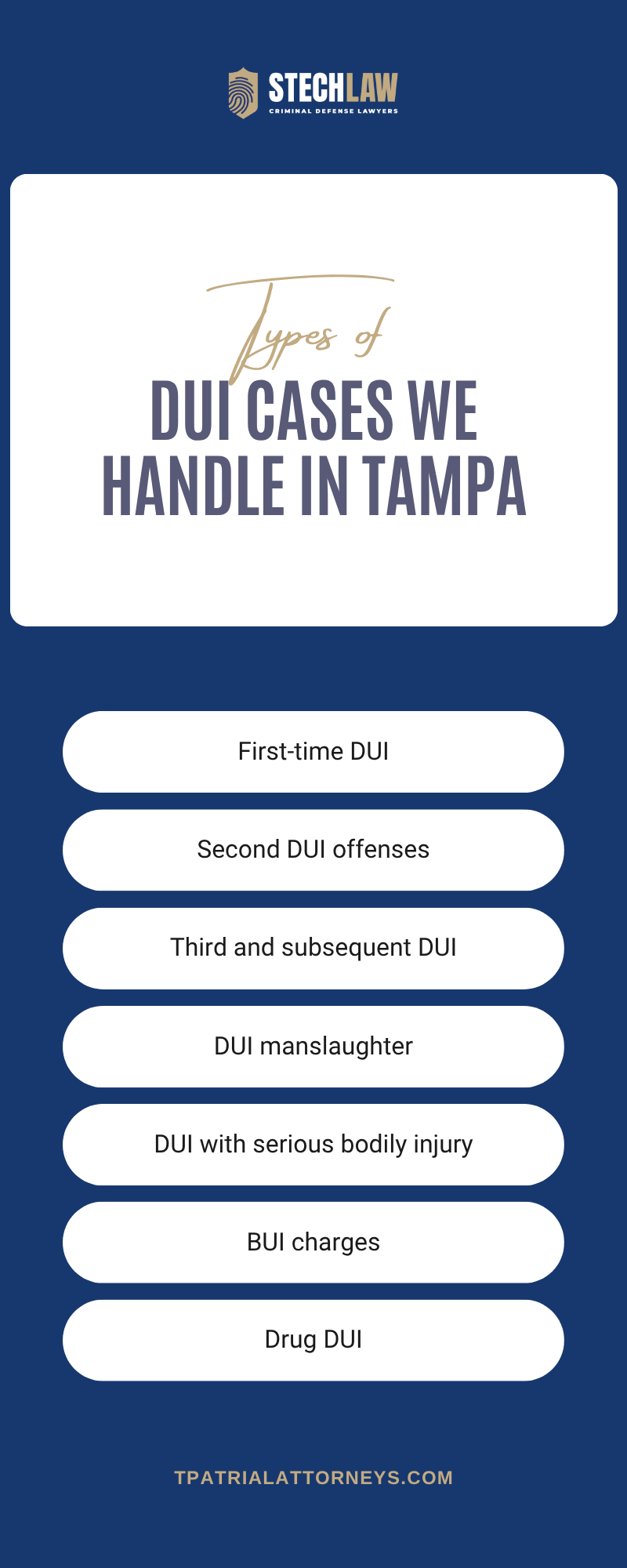
Types of DUI Cases We Handle in Tampa
 DUI charges in Florida cover far more ground than most people realize. The specific charge you’re facing determines the potential penalties, available defenses, and realistic outcomes.
- First-time DUI. Standard first offenses carry fines up to $1,000, possible jail time up to six months, license suspension, mandatory DUI school, and probation. Many first-time offenders qualify for diversion programs that can result in reduced charges or dismissal. Our approach to first offense DUI defense focuses on protecting your record and minimizing long-term consequences.
- Second DUI offenses. A second DUI within five years of a prior conviction triggers mandatory minimum jail time of 10 days, with at least 48 consecutive hours required. Fines increase. License revocation extends to five years. The penalties for repeat offenses escalate rapidly, making aggressive defense even more important.
- Third and subsequent DUI. A third DUI within 10 years becomes a third-degree felony. Mandatory minimum jail is 30 days. License revocation lasts 10 years minimum. Fourth and subsequent offenses are always felonies regardless of timing. The collateral consequences of felony conviction extend far beyond the criminal sentence.
- DUI manslaughter. Causing death while driving impaired is a second-degree felony carrying up to 15 years in prison. If you leave the scene, it becomes a first-degree felony with up to 30 years. These are the most serious charges our firm handles, and they require immediate, intensive defense preparation.
- DUI with serious bodily injury. Causing serious injury while impaired is a third-degree felony with penalties up to five years in prison. The definition of “serious bodily injury” under Florida law is broad, and vehicular injury cases often involve complex causation questions.
- BUI charges. Operating a boat while impaired carries similar penalties to vehicle DUI. Florida aggressively enforces boating under the influence laws, particularly in the Tampa Bay area with its extensive waterways and recreational boating culture.
- Drug DUI. Impairment from marijuana, prescription medications, or illegal drugs qualifies as DUI under Florida law. No breathalyzer exists for drugs, so these cases rely heavily on officer observations and sometimes blood testing. Drug-related DUI charges present unique defense opportunities because proving impairment is more difficult for prosecutors.
Florida Legal Requirements for DUI Cases

Florida’s DUI statute is Section 316.193 of the Florida Statutes. The law defines DUI as operating a motor vehicle while impaired by alcohol or controlled substances to the extent that normal faculties are affected, or while having a blood or breath alcohol level of 0.08% or higher.
Standard First Offense Penalties
Fines between $500 and $1,000. Up to six months in jail. Probation up to one year. Mandatory 50 hours of community service. License revocation between 180 days and one year. Completion of DUI school. Vehicle impoundment for 10 days. Possible ignition interlock device.
Enhanced First Offense Penalties
If your BAC was 0.15% or higher, or if a minor was in the vehicle, penalties increase. Fines range from $1,000 to $2,000. Maximum jail time extends to nine months. Mandatory ignition interlock installation for at least six months.
Second Offense Penalties
Fines between $1,000 and $2,000 (or $2,000 to $4,000 if BAC was 0.15% or higher). Jail up to nine months, with mandatory minimum of 10 days if the second offense occurred within five years of the first. License revocation for at least five years if within five years of prior conviction. Mandatory ignition interlock for at least one year.
Felony DUI Penalties
Third DUI within 10 years: up to five years in prison, fines up to $5,000, 10-year license revocation minimum.
Fourth or subsequent DUI (regardless of timing): third-degree felony, up to five years in prison, permanent license revocation.
DUI manslaughter: up to 15 years (or 30 if leaving the scene), mandatory minimum four-year prison sentence.
Implied Consent Consequences
Under Florida’s implied consent law, refusing a breath, blood, or urine test triggers automatic administrative penalties. First refusal results in one-year license suspension. Second or subsequent refusal is a separate misdemeanor crime with additional penalties. These administrative consequences are handled by the Florida DHSMV, not the criminal court, and occur regardless of whether you’re ever convicted.
Important Defense Factors in Tampa DUI Cases
 Every DUI case has multiple potential weak points. Identifying and attacking these weaknesses is how cases get reduced or dismissed. StechLaw Criminal Defense examines every element of the arrest and prosecution.
Challenging the Traffic Stop
The Fourth Amendment prohibits unreasonable searches and seizures. An officer cannot pull you over without reasonable suspicion of criminal activity or a traffic violation. Common justifications include speeding, weaving between lanes, running red lights, or equipment violations like broken taillights.
But sometimes the stated reason doesn’t match reality. Dashcam footage shows steady driving despite the officer’s claim of weaving. The “broken taillight” was actually functioning. The alleged speeding can’t be verified. When the stop itself was improper, everything that followed becomes potentially inadmissible. We obtain body camera footage and dashcam recordings in every case to compare against the officer’s written report.
Field Sobriety Test Problems
The National Highway Traffic Safety Administration validated three standardized field sobriety tests: horizontal gaze nystagmus (HGN), walk-and-turn, and one-leg stand. Officers receive specific training on administering and scoring these tests. Proper administration requires following detailed protocols.
Officers frequently deviate from these protocols. They give incomplete instructions. They skip demonstrations. They administer tests on uneven surfaces or in poor lighting. They score subjectively rather than following standardized criteria. And even when perfectly administered, peer-reviewed research shows these tests produce false positive results in sober individuals with concerning frequency. Medical conditions affecting balance, inner ear problems, neurological issues, fatigue, anxiety, and improper footwear all compromise results.
Breath Test Accuracy Issues
Florida uses the Intoxilyzer 8000 for evidential breath testing. The machine requires calibration at regular intervals and maintenance according to manufacturer specifications. The operator must hold current certification from FDLE. A 20-minute observation period must precede testing to ensure nothing in the defendant’s mouth affects results.
Errors occur at every stage. Machines fall out of calibration. Maintenance gets delayed. Operators let certifications lapse. Observation periods get cut short or interrupted. We subpoena calibration logs, maintenance records, operator certification documents, and testing protocols. When breath test reliability is compromised, the state’s case often weakens significantly.
Blood Test Chain of Custody
Blood draws require proper medical personnel, appropriate equipment, and documented chain of custody from collection through analysis. Samples must be stored correctly to prevent degradation. Testing must follow established protocols. Any break in this chain creates questions about reliability.
Miranda and Constitutional Issues
Officers must provide Miranda warnings before custodial interrogation. The question of when a traffic stop becomes custodial is often contested. Statements made before proper warnings may be suppressible. Our Miranda violations practice examines the timing and circumstances of every statement our clients made.
Rising Blood Alcohol Defense
Alcohol takes time to absorb into the bloodstream. If you were tested 30-60 minutes after driving, your BAC at the time of testing may have been higher than at the time of driving. This “rising blood alcohol” defense can create reasonable doubt about whether you were actually over the legal limit when behind the wheel.
What Steps Should I Take After a DUI Arrest in Tampa?

The days immediately following arrest are critical. Your actions during this window affect both your license and your criminal case.
- Request your DMV hearing within 10 days. Florida law gives you exactly 10 calendar days from arrest to request a formal review hearing challenging your license suspension. Miss this deadline and administrative suspension becomes automatic. File through the Bureau of Administrative Reviews or have your attorney file immediately upon retaining us. This DMV hearing is separate from your criminal case.
- Document the arrest in detail. While memory remains fresh, write down everything. Where were you before driving? What and how much did you consume, over what time period? What did the officer say during the stop? How were field sobriety tests administered? What were road and weather conditions? These details matter and fade quickly.
- Identify potential witnesses. Anyone who observed you before driving can provide testimony about your condition. Passengers, bartenders, servers, friends at the gathering you left. Their observations might contradict what the officer claims to have seen.
- Stay off social media. Do not post anything about your arrest, the circumstances leading up to it, or your legal situation. Do not discuss it in comments or messages. Prosecutors and investigators monitor social media, and posts can become evidence.
- Comply with bond conditions. Your release likely came with conditions such as no alcohol consumption, no new law violations, and possible check-ins. Violating these conditions can result in bond revocation and additional charges. If you’re arrested while your DUI is pending, your situation becomes significantly more complicated.
- Attend every court date. Missing court results in a bench warrant for your arrest and potential additional charges. It also signals to judges that you’re not taking the matter seriously, which affects how they view requests for leniency. If you have a conflict, notify your attorney in advance so we can seek a continuance.
- Explore hardship license options. If you need to drive for work, medical appointments, or family obligations, you may qualify for a hardship license. Completing DUI school promptly can expedite eligibility.
- Understand your driving situation. If you hold a CDL, the consequences extend beyond criminal penalties. Even a first DUI results in commercial driving disqualification for one year. Second offense means permanent disqualification.
Tampa DUI Defense Infographic
DUI Enforcement Statistics in Tampa
 Understanding enforcement patterns helps contextualize what you’re facing. Hillsborough County is one of Florida’s most aggressive jurisdictions for DUI prosecution.
The Florida DHSMV documented over 5,000 alcohol-related crashes statewide in 2023. Hillsborough County consistently ranks in the top five Florida counties for DUI arrests. Tampa Police Department, Hillsborough County Sheriff’s Office, and Florida Highway Patrol all actively enforce impaired driving laws throughout the county.
According to the National Highway Traffic Safety Administration, approximately one-third of all traffic fatalities nationwide involve alcohol-impaired drivers. This statistic drives federal funding priorities. Law enforcement agencies receive grants specifically for DUI checkpoints, saturation patrols, and enforcement campaigns during holidays and special events.
Tampa’s entertainment districts see concentrated enforcement. Ybor City, SoHo, and downtown Tampa during events like Gasparilla generate significant DUI arrest numbers. Holiday weekends, particularly around New Year’s Eve, Fourth of July, and Thanksgiving, see increased patrol activity and checkpoint deployment.
The CDC reports that alcohol-impaired driving remains among the leading causes of preventable traffic deaths in the United States. This public health framing influences how prosecutors and judges approach DUI cases. They see themselves as protecting the community, which affects their willingness to negotiate and their sentencing decisions.
Florida’s zero tolerance law for drivers under 21 means a BAC of just 0.02% can result in license suspension. This catches young people who had a single drink and assumed they were fine to drive.
Tampa DUI Defense Lawyer FAQs
What’s the difference between DUI and DWI?
 Florida uses the term DUI (Driving Under the Influence). Some states use DWI (Driving While Intoxicated) or OUI (Operating Under the Influence). They describe essentially the same offense. In Florida, you’ll only encounter DUI in statutes and charging documents.
Can a DUI be reduced to a lesser charge?
Yes. Depending on the evidence and circumstances, DUI charges can sometimes be reduced to reckless driving. This is sometimes called “wet reckless” because it arose from alcohol-related conduct. A reckless driving conviction carries fewer penalties than DUI and does not trigger the same license consequences or insurance impacts.
What happens if I refuse the breath test?
Refusal triggers automatic one-year license suspension under implied consent, regardless of whether you’re ever convicted. The refusal can also be mentioned at trial, though juries hear instructions that refusal alone doesn’t prove guilt. However, the state has no breath test number to present, which can actually help your defense. Refusal cases require different strategic approaches.
How does DUI affect my driver’s license?
Administrative suspension begins upon arrest for failing or refusing the breath test. First failure means six-month suspension. First refusal means one-year suspension. Criminal conviction brings additional revocation ranging from 180 days to permanent depending on offense history. The license consequences often matter more to clients than fines or even jail time.
Will I definitely go to jail for DUI?
Not necessarily. Most first-time DUI offenders in Hillsborough County don’t serve jail time absent aggravating factors. Second and subsequent offenses carry mandatory minimums that require some incarceration. Felony DUI charges carry substantial prison exposure. Outcomes depend heavily on case-specific facts and the quality of defense representation.
Is DUI a felony in Florida?
A first, second, or third DUI is typically a misdemeanor in Florida. Third DUI within 10 years of a prior becomes a felony. Fourth or subsequent DUI is always a felony regardless of timing. DUI causing serious injury or death is a felony regardless of prior history.
How much does a DUI conviction actually cost?
Direct costs include fines ($500-$5,000 depending on offense), court costs ($300-$500), DUI school ($250-$300), substance abuse evaluation ($75-$150), and possible ignition interlock ($70-$150 monthly). Indirect costs include increased insurance premiums for years, potential lost employment, and long-term financial impact that often reaches $10,000-$20,000 or more.
Can I get a DUI expunged in Florida?
No. DUI convictions in Florida cannot be expunged or sealed under any circumstances. They remain on your criminal record permanently. This makes fighting the charge or securing alternative dispositions particularly important.
What is the 10-day rule for DUI?
After DUI arrest, you have exactly 10 calendar days to request a formal review hearing with the DMV regarding your license suspension. Weekends and holidays count toward this deadline. Missing it means automatic suspension with no opportunity to challenge. We can file this request immediately upon being retained.
How long will my DUI case take?
Most misdemeanor DUI cases in Hillsborough County resolve within three to six months. Cases involving motion practice, expert witnesses, or trial take longer. Felony DUI cases typically extend six months to a year or more depending on complexity.
What defenses work for DUI charges?
Common successful defenses include challenging the validity of the traffic stop, attacking field sobriety test administration, questioning breath test accuracy and maintenance, raising blood test chain of custody issues, and identifying Miranda violations. Not every case has strong defense angles, but many DUI arrests contain errors that compromise the prosecution’s case.
Should I hire a lawyer for DUI?
You’re not legally required to have representation. But DUI defense involves technical areas including standardized field sobriety test protocols, breath testing science, constitutional search and seizure law, and complex procedural requirements. Prosecutors handle these cases daily and know the system intimately. Having experienced defense counsel levels that imbalance.
Does DUI affect professional licenses?
Many licensing boards require disclosure of criminal convictions and may initiate disciplinary proceedings. Healthcare workers, teachers, attorneys, real estate agents, and many other professionals face potential license consequences beyond criminal penalties. If you hold a medical license or other professional credential, the stakes of your DUI case extend significantly beyond court.
What if I was arrested for DUI but wasn’t driving?
Florida law covers “actual physical control” of a vehicle, not just driving. Sitting in a parked car with keys accessible can qualify. However, physical control cases present defense opportunities that aren’t available when someone was clearly driving.
Can I travel internationally with a DUI conviction?
Some countries, including Canada, restrict entry for people with DUI convictions. The impact depends on the specific country and the nature of your conviction. International travel implications are another reason to fight DUI charges aggressively.
What Happens During Your Tampa DUI Case
 DUI cases in Hillsborough County follow a general procedural pattern. Understanding the timeline helps you know what to expect.
Arrest and Bond
After arrest, you’ll typically be transported to Hillsborough County Jail for booking. Bond is usually set according to a standard schedule for misdemeanor DUI. You may be released the same day or, if arrested on a weekend, may wait until Monday to see a judge. Bond conditions typically include no alcohol consumption and sometimes installation of an ignition interlock device.
Arraignment
Your first court appearance is arraignment, typically scheduled two to four weeks after arrest. The judge reads the formal charges and asks for your plea. We enter not guilty and request discovery. Arraignment itself is procedural and quick. The substantive work begins after.
Discovery and Investigation
The state must provide evidence it intends to use. This includes police reports, arrest affidavits, breath test results, calibration and maintenance records, video footage, and witness lists. We analyze everything for weaknesses. We may hire accident reconstructionists, toxicologists, or other consultants depending on the case. This phase identifies what defense angles exist.
Motion Practice
If investigation reveals constitutional violations or procedural errors, we file motions to suppress evidence or dismiss charges. Common motions challenge the traffic stop’s legality, breath test administration, or Miranda compliance. The state responds, the court holds hearings, and the judge rules. Successful motions can result in dismissal or significantly improve negotiating position.
Negotiation
Most DUI cases resolve through negotiation rather than trial. Options include reduction to reckless driving, enrollment in diversion programs, or negotiated pleas with reduced penalties. What’s achievable depends on the evidence, your history, and the specific prosecutor assigned to your case.
Trial
Cases that don’t settle proceed to trial. Ben’s 60+ jury trials mean StechLaw Criminal Defense knows how to present DUI defenses effectively to juries. We prepare thoroughly, including witness preparation, exhibit organization, and development of clear themes that resonate with jurors.
Sentencing
If convicted at trial or through plea, sentencing follows. Florida uses sentencing guidelines that provide ranges based on offense severity and criminal history. Mitigating factors can result in sentences below guideline recommendations. Aggravating factors can push sentences higher.
What Are Important Local Resources for Tampa DUI Cases?
 The following organizations may be helpful as you navigate the DUI process. Listing these resources does not constitute endorsement by StechLaw Criminal Defense.
Hillsborough County Clerk of Court – (813) 276-8100 – Court records, fine payment, and case scheduling information.
Florida DHSMV Bureau of Administrative Reviews (Tampa) – (813) 276-3001 – License suspension hearings and hardship license applications.
Hillsborough County Sheriff’s Office – (813) 247-8200 – Arrest records and property retrieval.
Tampa Police Department – (813) 231-6130 – For arrests made by Tampa city officers.
MADD Florida – (877) 275-6233 – Victim services and DUI information resources.
StechLaw Criminal Defense is not affiliated with these organizations.
StechLaw Criminal Defense, Tampa DUI Defense Lawyer
1105 W Swann Ave, Tampa, FL 33606
Contact StechLaw Criminal Defense
DUI charges in Tampa demand serious attention. The consequences reach into every area of life: employment, driving privileges, insurance costs, professional licenses, and personal reputation. But charges are not convictions. Evidence can be challenged. Procedures can be questioned. Alternative resolutions may be available.
StechLaw Criminal Defense offers free consultations for DUI cases. There’s no charge to sit down with Ben, review your situation, and hear an honest assessment of your options. Contact us to schedule a meeting with our Tampa DUI defense lawyer. The sooner we see the evidence, the more options we have to protect your future.