

 Last Updated: 10-13-2026
 Read Time – Est:

Federal Crimes Defense Lawyer Pinellas County, FL
If federal agents have contacted you, served you with a subpoena, or notified you that you are under investigation for a federal offense in Pinellas County, the decisions you make in the first few weeks will shape the direction of your case. Federal matters arising in St. Petersburg, Clearwater, Largo, and throughout Pinellas County are prosecuted by the United States Attorney’s Office for the Middle District of Florida, with cases heard in the federal courthouse in Tampa. The procedural framework differs materially from state practice.
Our Federal Crimes Defense Lawyer Pinellas County, FL has practiced criminal defense in the Tampa Bay area for nearly 15 years. Contact our firm today to schedule a complimentary consultation.

Why Choose StechLaw Criminal Defense for Federal Crimes Defense in Pinellas County, FL?
Federal prosecutions carry consequences that extend well beyond the immediate sentence. Asset forfeiture proceedings, civil enforcement actions by regulatory agencies, professional license revocations, and immigration implications often run parallel to the criminal case and can persist long after the federal matter has been resolved. Effective defense requires counsel who understand these interlocking consequences and prepare each matter with attention to the full scope of exposure.
Former Prosecutor Perspective
Ben Stechschulte served as a prosecutor in Hillsborough County before establishing his defense practice. That experience informs the analytical framework he applies to federal matters, including evaluation of evidentiary strength, assessment of cooperator credibility, and identification of the charging theories prosecutors are most likely to pursue in a given fact pattern. Understanding how the other side thinks is foundational to effective defense work.
Board Certification and Trial Experience
Mr. Stechschulte is board certified in criminal trial law by The Florida Bar, a credential held by approximately one percent of Florida attorneys. He has tried more than 60 cases to verdict, a body of trial experience that informs his approach to both contested matters and plea negotiations. He earned his Juris Doctor from Stetson University College of Law and was named a Super Lawyers Rising Star in 2015.
Middle District of Florida CJA Panel
Mr. Stechschulte has been appointed by the United States Magistrate Judge for the Middle District of Florida to the federal Criminal Justice Act conflict panel. The appointment is reserved for attorneys whose qualifying federal trial experience and professional standing meet court-established criteria, and it reflects ongoing engagement with federal matters arising throughout the district, including Pinellas County cases.
Complimentary Consultations for Pinellas County Clients
We provide free case evaluations for federal matters. The attorney conducting the initial consultation remains directly responsible for the representation. Matters being handled by other counsel are welcome for second opinion consultation at no cost.
⭐⭐⭐⭐⭐ “I had an outstanding experience with Attorney Ben and his team. He is not only professional, but truly an expert in his field — extremely knowledgeable and experienced. I would highly, highly recommend anyone needing legal support to reach out to him.” — Jay Monarch
Additional client reviews are available on our Google Business Profile.

Types of Federal Crimes Cases We Handle in Pinellas County
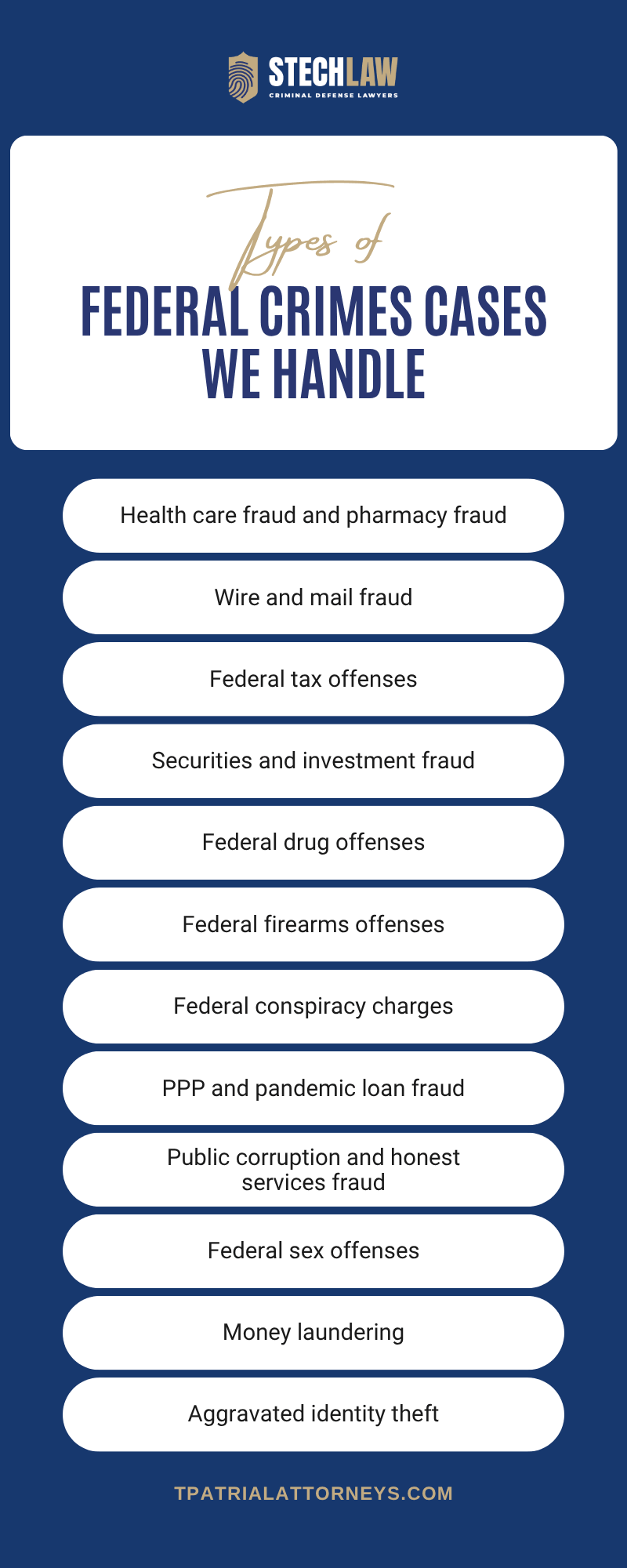
Federal offenses arising in Pinellas County span a broad range of statutory provisions. The investigating agency, the charged statute, and the strength of the evidentiary record each shape the defense strategy available in a given matter. Our firm represents clients in federal matters of the following types:
- Health care fraud and pharmacy fraud. Prosecutions under 18 U.S.C. § 1347 involving billing irregularities, upcoding, medically unnecessary services, and kickback allegations investigated by the Department of Health and Human Services Office of Inspector General and the FBI.
- Wire and mail fraud. Prosecutions under 18 U.S.C. §§ 1341 and 1343, which constitute the statutory backbone of most federal white collar cases. The jurisdictional element is routinely satisfied through electronic communications or postal activity.
- Federal tax offenses. Matters under Title 26 of the Internal Revenue Code involving tax evasion, willful failure to file, filing of false returns, and structuring transactions to evade currency reporting requirements. IRS Criminal Investigation Division leads these matters.
- Securities and investment fraud. Federal prosecutions involving Ponzi schemes, insider trading, investment adviser fraud, and related securities law violations. These matters frequently involve parallel enforcement actions by the Securities and Exchange Commission.
- Federal drug offenses. Trafficking, distribution, and conspiracy charges under 21 U.S.C. §§ 841 and 846. Quantity-based mandatory minimum provisions frequently dominate sentencing considerations.
- Federal firearms offenses. Charges under 18 U.S.C. §§ 922 and 924 including felon-in-possession allegations and firearms used in connection with drug trafficking or violent offenses, with federal firearms matters subject to enhanced mandatory minimum provisions.
- Federal conspiracy charges. Allegations under 18 U.S.C. § 371 and substantive conspiracy provisions that frequently accompany drug, fraud, and firearms offenses, expanding co-conspirator liability across the charged scheme.
- PPP and pandemic loan fraud. Ongoing federal prosecutions addressing fraudulent Paycheck Protection Program applications, false certifications, and misuse of loan proceeds. Related Economic Injury Disaster Loan matters fall within the same enforcement framework.
- Public corruption and honest services fraud. Federal prosecutions under 18 U.S.C. § 1346 imposing fiduciary-based liability on public officials and private sector actors.
- Federal sex offenses. Prosecutions involving interstate transportation, child exploitation, and internet-based offenses, typically investigated by the FBI and Homeland Security Investigations.
- Money laundering. Charges under 18 U.S.C. §§ 1956 and 1957 addressing financial transactions involving proceeds of specified unlawful activity. Transaction tracing and the structuring of financial activity frequently form the central evidentiary issues.
- Aggravated identity theft. Charges under 18 U.S.C. § 1028A carrying a mandatory two-year consecutive sentence upon conviction.

Federal Legal Requirements for Criminal Defense
Federal criminal prosecutions are governed by procedural rules, evidentiary standards, and sentencing frameworks that differ materially from Florida state practice. The Federal Rules of Criminal Procedure establish the procedural requirements applicable at every stage. Substantive criminal provisions are codified principally in Title 18 of the United States Code, with controlled substance offenses addressed in Title 21 and tax crimes in Title 26.
The majority of federal felony prosecutions are initiated by indictment returned by a federal grand jury. The grand jury operates under rules that differ substantially from trial practice, including the absence of defense counsel during witness testimony and the admissibility of hearsay evidence. Witnesses served with federal grand jury subpoenas require counsel to navigate the scope of testimony and the assertion of applicable privileges.
Federal sentencing proceeds under the advisory United States Sentencing Guidelines. Federal judges calculate the applicable guideline range and consider it alongside the statutory factors at 18 U.S.C. § 3553(a). Mandatory minimum sentences established by Congress operate independently of the guideline calculation and can substantially restrict the range of available sentencing outcomes. For qualifying defendants in drug cases, the statutory safety valve at 18 U.S.C. § 3553(f) provides a narrow pathway to sentencing below the mandatory minimum.
Parallel civil, regulatory, and forfeiture proceedings routinely accompany federal criminal matters. Statements made in one forum may be used against a defendant in another. The Securities and Exchange Commission, the Federal Trade Commission, the Department of Health and Human Services, the Florida Department of Health, and state professional licensing boards frequently pursue enforcement actions alongside federal criminal cases. Strategic coordination across forums is essential to avoiding inadvertent prejudice.

Important Aspects of a Pinellas County Federal Crimes Case
Investigative Status and Early Engagement
Individuals contacted by federal investigators fall into one of three categories under Department of Justice guidelines: subject, witness, or target. The designation materially affects the strategic posture of the defense. Confirming your status as a target of federal investigation or in a lesser capacity frequently requires direct inquiry of the investigating agency or the United States Attorney’s Office through counsel. Pre-indictment engagement often provides the most meaningful window to influence the ultimate charging decision.
Detention Hearings and Pretrial Release
Federal detention operates under the Bail Reform Act at 18 U.S.C. § 3142. For certain categories of offenses, including drug offenses carrying statutory maximum penalties of ten years or greater and firearms charges under 18 U.S.C. § 924(c), a statutory presumption of detention applies. Rebutting the presumption requires presentation of evidence regarding employment, residence, community ties, available third-party custodians, and proposed supervision conditions such as location monitoring.
Asset Forfeiture Exposure
Federal criminal cases routinely involve parallel forfeiture proceedings under 18 U.S.C. §§ 981 and 982 and related statutes. The scope of federal asset forfeiture can encompass proceeds of the offense, property used to facilitate the offense, and substitute assets where direct proceeds are unavailable. For Pinellas County clients, forfeiture often reaches accounts, real property, and vehicles that seem only tangentially connected to the alleged conduct. The timing of forfeiture negotiations can significantly affect the final disposition.
Cooperation Analysis
Federal law provides multiple mechanisms for sentence reduction through cooperation with the government. Substantial assistance motions under U.S.S.G. § 5K1.1 and Federal Rule of Criminal Procedure 35(b) require the government’s formal motion. The decision whether to pursue cooperation involves considerations extending beyond the immediate sentencing benefit, including personal safety, implications for co-defendants and family members, and the scope of required disclosures. Proffer sessions conducted to evaluate cooperation potential carry their own procedural protections that require careful negotiation.
Sentencing Mitigation and Variance Motions
Federal sentencing is frequently the most consequential stage of the proceeding. Mitigation presentations addressing the client’s background, employment history, family responsibilities, rehabilitation efforts, medical and mental health considerations, and military service can meaningfully influence the final disposition. Variance motions based on the § 3553(a) factors provide the principal mechanism for departure below the advisory guideline range in matters not involving mandatory minimums. Resources from the United States Sentencing Commission address the guideline calculation methodology.
Post-Conviction Supervised Release
Federal sentences typically include a term of supervised release following imprisonment. The conditions of supervised release are established by the sentencing court and enforced by federal probation officers. Violation proceedings are adjudicated under procedures that differ from the original criminal case, with reduced evidentiary burdens and restricted procedural protections. Clients facing federal sentencing should understand the supervised release component as an integral part of the sentence rather than a post-sentence afterthought.
Contact StechLaw Criminal Defense
If you have received a target letter, been served with a federal grand jury subpoena, been contacted by federal agents, or been indicted on federal charges arising in Pinellas County, prompt consultation preserves the full scope of available legal options. For additional procedural context relevant to Pinellas County federal matters, our Pinellas County federal criminal defense page addresses related considerations.
Our firm provides complimentary case evaluations for federal criminal matters. During the consultation, we will review the investigative posture, evaluate the governing statutory framework, and outline the anticipated course of representation. Contact us today.

Federal Crime Statistics in Pinellas County, FL
Pinellas County federal prosecutions fall under the jurisdiction of the Middle District of Florida, one of the most active federal districts in the country by criminal caseload. Sentencing data published annually by the U.S. Sentencing Commission shows that drug trafficking, fraud-related offenses, and firearms violations account for the largest share of cases sentenced in this district each year. The FBI consistently places Florida among the highest-volume states for federal white collar enforcement activity, and healthcare fraud investigations across the Tampa Bay corridor have expanded substantially over the past several years. Federal defendants convicted in this district serve average custody terms that typically exceed what comparable conduct draws in Florida state court. For residents of St. Petersburg, Clearwater, and throughout Pinellas County, FL, those numbers have direct relevance.
10 Important Steps in a Pinellas County Federal Criminal Defense Case
Federal prosecutions do not follow the same path as Florida state criminal matters. The agencies involved, the procedural framework, and the decisions that carry the most lasting weight differ substantially. Here is how federal criminal defense cases in Pinellas County, FL, typically develop from the earliest investigative stage through sentencing.
- Retain defense counsel immediately. The moment you become aware of a federal investigation, whether through agent contact, a target letter, or indirect information, retain a federal crimes defense attorney in Pinellas County. Early engagement preserves options that narrow significantly once an indictment controls the framework.
- Determine your investigative status. Federal investigators classify individuals as targets, subjects, or witnesses. Those designations carry different strategic implications. Confirming your status through defense counsel, rather than through voluntary agent contact, sets the appropriate posture for everything that follows.
- Protect your right to remain silent. Your Fifth Amendment rights apply from first contact with federal agents. Voluntary statements made before retaining counsel have consistently damaged defendants in Middle District matters. No obligation to speak exists outside a formal proceeding, and invoking silence carries no trial penalty.
- Navigate any grand jury proceedings carefully. If a grand jury subpoena arrives for documents or testimony, defense counsel prepares you for the scope of what is required and identifies applicable privileges. The grand jury process operates under rules that differ substantially from trial, where hearsay is admissible and defense counsel cannot be present during witness testimony.
- Respond to the detention hearing. After a federal arrest, a magistrate judge holds a detention hearing. The defense presents evidence of employment, residence, community ties, and proposed supervision conditions. For drug charges with ten-year mandatory minimums and certain firearms offenses, a presumption of detention must be affirmatively overcome before release becomes available.
- Review discovery and pursue pretrial motions. Government disclosure in federal cases typically includes financial records, agent reports, surveillance data, and cooperator statements. Suppression motions challenging unlawful searches can remove key evidence from the case entirely. Defects in the charging instrument sometimes support dismissal of individual counts before trial.
- Evaluate any plea offer with full information. The majority of federal matters in the Middle District resolve through plea agreements rather than trial. The charge of conviction drives the guideline calculation. Evaluating a plea offer requires a command of both the evidence and the statutory framework, not just the surface terms of what the government is proposing.
- Assess whether cooperation makes strategic sense. Cooperation is not appropriate in every case, and the decision involves more than potential sentencing benefit. Where it makes sense, timing and structure matter considerably. Federal pretrial services and formal cooperation agreements are distinct processes with separate procedural protections.
- Build a full sentencing defense. Federal sentencing frequently determines the real-world impact of the case. A defense memorandum presenting guideline objections, mitigating factors, and arguments under the applicable statutory sentencing factors can produce meaningful sentence reductions for qualifying defendants.
- Plan for supervised release compliance. Federal sentences include a supervised release term following any period of incarceration. Conditions typically address employment, travel, financial disclosure, and contact restrictions. Planning for compliance from the outset of sentencing reduces the risk of violation proceedings that could return a defendant to custody months or years later.
Pasco County Federal Criminal Defense Infographic
Pinellas County Federal Defense Lawyer FAQs
How is a federal case different from a Florida state case?
Federal charges are investigated by agencies like the FBI, DEA, and IRS and prosecuted by the U.S. Attorney’s Office. They are adjudicated in U.S. District Court in Tampa under the Federal Rules of Criminal Procedure. Sentencing follows the U.S. Sentencing Guidelines, mandatory minimums apply to many offense categories, and federal custody terms in the Middle District consistently exceed comparable Florida state outcomes.
What is the federal statute of limitations?
Most non-capital federal felonies carry a five-year limitations period under 18 U.S.C. § 3282. Specific statutes extend that window considerably. Tax offenses run six years, and bank fraud carries ten. If investigators have already made contact, the investigation is typically further advanced than it appears from the outside.
What should I do if I receive a federal target letter?
Stop and retain defense counsel before doing anything else. Do not respond to the letter, contact investigators, or reach out to potential co-defendants. A target letter signals that the grand jury views you as a subject of an active investigation. The response strategy established in those first days shapes the entire case from that point forward.
Should I speak with federal agents before hiring an attorney?
No. The Fifth Amendment right to remain silent applies from first contact and carries no trial penalty. Federal agents conducting pre-indictment interviews are building a case. Even well-intentioned statements can be used in ways that harm the defense. All government contact should route through defense counsel from the moment a federal investigation becomes known to you.
Can federal charges be dismissed or reduced?
Yes. Suppression motions can exclude evidence obtained through unlawful searches or seizures. Defects in the indictment can support dismissal of individual counts. Pre-indictment, the U.S. Attorney’s Office sometimes declines to proceed based on the available evidence. Charge reductions are regularly negotiated as part of the plea process where the underlying facts support them.
What happens at a federal detention hearing?
A magistrate judge evaluates pretrial release conditions under the Bail Reform Act. The defense presents evidence of employment, community ties, and proposed supervision. For drug offenses with ten-year mandatory minimums and certain firearms charges, a statutory presumption of detention applies and must be overcome through a targeted evidentiary presentation at the hearing itself.
Can I face both federal and Florida state charges for the same conduct?
Yes. The dual sovereignty doctrine permits parallel federal and Florida prosecutions arising from the same underlying facts. Drug trafficking, firearms, and fraud matters are the most common contexts where both jurisdictions pursue independent charges. When parallel proceedings are active, defense strategy across both courts requires coordination from the outset.
What are the most common federal charges in Pinellas County?
Drug trafficking, wire and mail fraud, healthcare fraud, federal firearms offenses, and aggravated identity theft arise frequently in Middle District matters involving Pinellas County defendants. Federal conspiracy charges accompany most of these categories and expand liability across all participants in an alleged scheme. PPP loan fraud prosecutions remain an active enforcement priority in this district.
How long does a federal criminal case typically take?
Federal investigations frequently run for months or years before charges are filed. After indictment, pretrial proceedings in the Middle District typically span six to eighteen months before a trial or plea resolution. Complex fraud and multi-defendant matters generally take longer. The federal timeline differs substantially from what most clients have experienced in Florida state court.
What happens during a federal grand jury proceeding?
A grand jury evaluates government evidence and determines whether probable cause supports filing charges. Proceedings are confidential. Defense counsel cannot attend witness testimony, and hearsay is admissible. The indictment process at the federal level gives the government structural advantages that make pre-indictment engagement with a federal defense attorney especially important.
How does federal sentencing work?
The sentencing judge calculates an advisory range under the U.S. Sentencing Guidelines based on offense level and criminal history category. A defense memorandum addressing the federal sentencing guidelines and applicable statutory factors gives the court the fullest basis for exercising its available discretion. Mandatory minimums, where applicable, restrict that discretion independently of the guideline range.
What should I expect from a consultation at StechLaw Criminal Defense?
We review the facts, assess the governing statutory framework, and give you a direct read on where things stand. There is no fee and no obligation. The attorney who conducts the initial consultation handles the case going forward. We discuss the government’s likely theory, your options at each stage, and what the defense process involves for your specific situation.
Local Information for Pinellas County Federal Criminal Defense Cases
Pinellas County Courthouses and Local Criminal Justice Resources
Federal criminal proceedings arising in Clearwater, St. Petersburg, Largo, and throughout Pinellas County are adjudicated at the Sam M. Gibbons U.S. Courthouse in Tampa, the operational seat of the Middle District of Florida. Arraignments, pretrial hearings, jury trials, and sentencing all take place at that facility. Federal defendants remanded to custody pending trial are typically housed at the Federal Detention Center in Tampa. The judicial practices, assignment procedures, and procedural customs of the Middle District differ from Florida state court in ways that require specific, current familiarity developed through sustained federal court practice.
What Are Important Local Resources for Pinellas County Federal Criminal Defense?
The resources listed below may be relevant to individuals facing federal criminal charges in Pinellas County, FL. This information is provided for general reference only. StechLaw Criminal Defense does not endorse and has no affiliation with any organization or agency listed here.
- Sam M. Gibbons U.S. Courthouse — 801 N. Florida Ave., Tampa, FL 33602 — (813) 301-5400. The federal courthouse where all Pinellas County Middle District criminal matters are adjudicated, including arraignments, detention hearings, trials, and sentencing. ⚠️ Verify internal URL before publishing.
- Federal Detention Center Tampa — 501 N. Oregon St., Tampa, FL 33602 — (813) 228-2538. Bureau of Prisons pretrial detention facility serving federal defendants in the Tampa Bay region, including those from Pinellas County awaiting resolution of their federal matters.
- U.S. Probation and Pretrial Services, Middle District of Florida — 801 N. Florida Ave., Tampa, FL 33602 — (813) 301-5560. Supervises defendants released under pretrial conditions and those completing supervised release terms following a federal sentence in this district.
- Pinellas County Jail — 14400 49th St. N., Clearwater, FL 33762 — (727) 464-6200. County detention facility where individuals may be held following a local arrest before any transfer to federal custody occurs.
About StechLaw Criminal Defense
StechLaw Criminal Defense represents clients facing federal criminal charges throughout Pinellas County, FL, with cases adjudicated at the U.S. District Court in Tampa. Our firm has obtained favorable outcomes in federal matters prosecuted in the Middle District of Florida, including a drug conspiracy acquittal secured after a full jury trial. Complimentary evaluations are available for federal criminal matters at every stage, from pre-charge investigation through post-sentencing review. Contact our Pinellas County office directly to schedule yours.
What Our Clients Say
⭐⭐⭐⭐⭐
“Ben is a true professional, and excellent advocate! I have coordinated with him on several complex federal white collar cases, and can say without a doubt that he communicates clearly and thoroughly at every step of the way, while zealously advocating for his clients rights. Highly recommend working with Ben and his team!”
— Rebecca Deming
Read more reviews on our Google Business Profile.
Contact StechLaw Criminal Defense
Federal charges affect more than the immediate criminal case. Careers, professional licenses, immigration status, and family finances are all in play when a federal investigation or indictment is underway. If you are facing federal charges in Pinellas County, FL, early consultation with a federal criminal defense attorney preserves options that narrow as the case progresses. We offer complimentary evaluations for all federal matters with no obligation. Our office answers calls around the clock and responds to consultation requests the same business day. Contact us to schedule yours.